Polecat Safaris
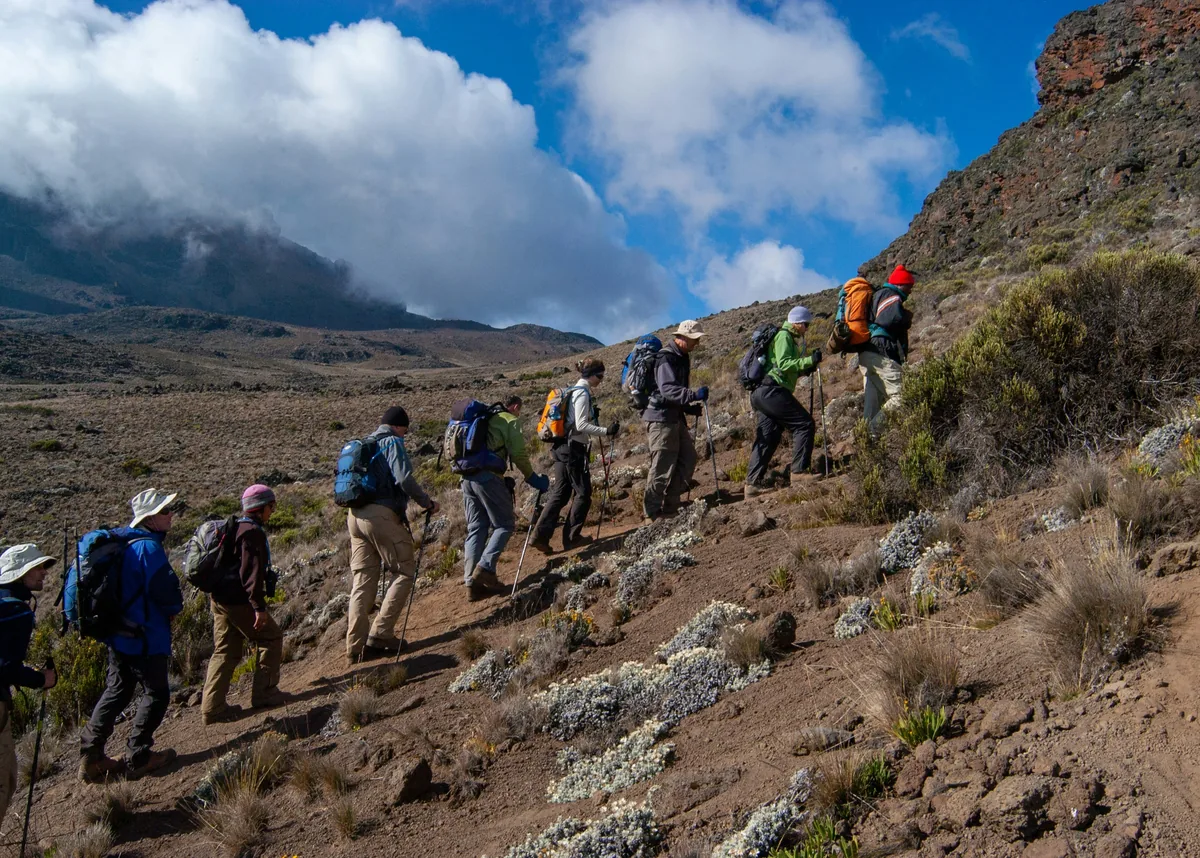
Trekkers on a rocky trail down towards the Saddle, the wide cone of Kibo filling the horizon ahead of them

Kilimanjaro Trek

7-Day Rongai Route

Duration
7 Days
From
US$ 2,520 per person

Overview

The only major route that comes at Kilimanjaro from the north, starting near the Kenyan border. Quieter trails, open country, and an extra acclimatisation day at Mawenzi Tarn beneath the most dramatic camp on the mountain — then across the Saddle to Kibo and the summit.

  • The only main Kilimanjaro route approaching from the north
  • The quietest trails on the mountain, and a different view of it
  • Comparatively drier going when the southern slopes are getting the rain
  • An extra acclimatisation day at Mawenzi Tarn, beneath Mawenzi Peak
  • The Saddle — the high desert between Mawenzi and Kibo — crossed on foot
  • Uhuru Peak at 5,895 metres, reached at sunrise
  • A descent by the Marangu route, so you come down a different side
  • A hot shower and a complimentary massage waiting at the bottom
Duration
7 days, 6 nights
Destination
Kilimanjaro National Park
Stops
7
Experience
Kilimanjaro Trek
Best time
January – March & June – October

The route, and how far apart these places are

Arusha · Rongai Gate · Kikelewa · Mawenzi Tarn · Kibo Hut · Uhuru Peak · Marangu Gate

Route Map

Day by day

Every day here is private — your own guide and your own vehicle — so the order holds but the hours are yours to move.

Day 1 01

Arusha or Moshi – Rongai Gate – Simba Camp

After breakfast you drive out to Rongai Gate, close to the Kenyan border, for registration and the park formalities.

From the gate the trail climbs gently through forest and the northern foothills, with birdlife and forest game along the way.

You reach Simba Camp in the afternoon and settle in for your first evening on the mountain.

Elevation
1,997 m – 2,635 m (+638 m)
Distance
Approx. 7 km
Hiking
3–4 hours
Habitat
Rainforest
Meals
Breakfast, lunch & dinner
Overnight
Simba Camp
Day 2 02

Simba Camp – Kikelewa Cave

The longest day of the climb. The forest opens into moorland as the trail works its way up towards Kikelewa Cave, with lunch somewhere along it.

By the afternoon the country is wide and open, and the view runs right out across northern Tanzania.

Elevation
2,635 m – 3,600 m (+965 m)
Distance
Approx. 17 km
Hiking
6–7 hours
Habitat
Moorland
Meals
Breakfast, lunch & dinner
Overnight
Kikelewa Cave Camp
Day 3 03

Kikelewa Cave – Mawenzi Tarn

A shorter day, but a steeper one, up through high moorland and increasingly broken ground.

Mawenzi Tarn is the most spectacular camp on Kilimanjaro — a small tarn under the volcanic spires of Mawenzi itself. Settle in and look up.

Elevation
3,600 m – 4,330 m (+730 m)
Distance
Approx. 7 km
Hiking
4–5 hours
Habitat
Semi-desert / alpine zone
Meals
Breakfast, lunch & dinner
Overnight
Mawenzi Tarn Camp
Highlight
Camp beneath the spires of Mawenzi
Day 4 04

Mawenzi Tarn – Acclimatisation Day

A day to slow down. You stay at Mawenzi Tarn and take a short acclimatisation walk around the area, which gives your body the time it needs before the summit stages.

With Mawenzi Peak rising straight out of the camp, it is also the best place on the mountain to stop and take in the size of the thing.

Habitat
Alpine desert
Meals
Breakfast, lunch & dinner
Overnight
Mawenzi Tarn Camp (Cont.)
Highlight
An extra day at 4,330 m, spent acclimatising rather than climbing
Day 5 05

Mawenzi Tarn – Kibo Hut

You leave Mawenzi and cross the Saddle, the broad high-altitude desert between Mawenzi and Kibo. Nothing much grows up here and the walking is stark and strange.

Kibo Hut sits at around 4,700 metres. Dinner is early and so is bed — the summit attempt starts around midnight.

Elevation
4,330 m – 4,695 m (+365 m)
Distance
Approx. 8 km
Hiking
4–5 hours
Habitat
Alpine desert
Meals
Breakfast, lunch & dinner
Overnight
Kibo Hut
Day 6 06

Kibo Hut – Uhuru Peak – Horombo Hut

Shortly after midnight, a hot drink and a light meal, and then the climb under the stars.

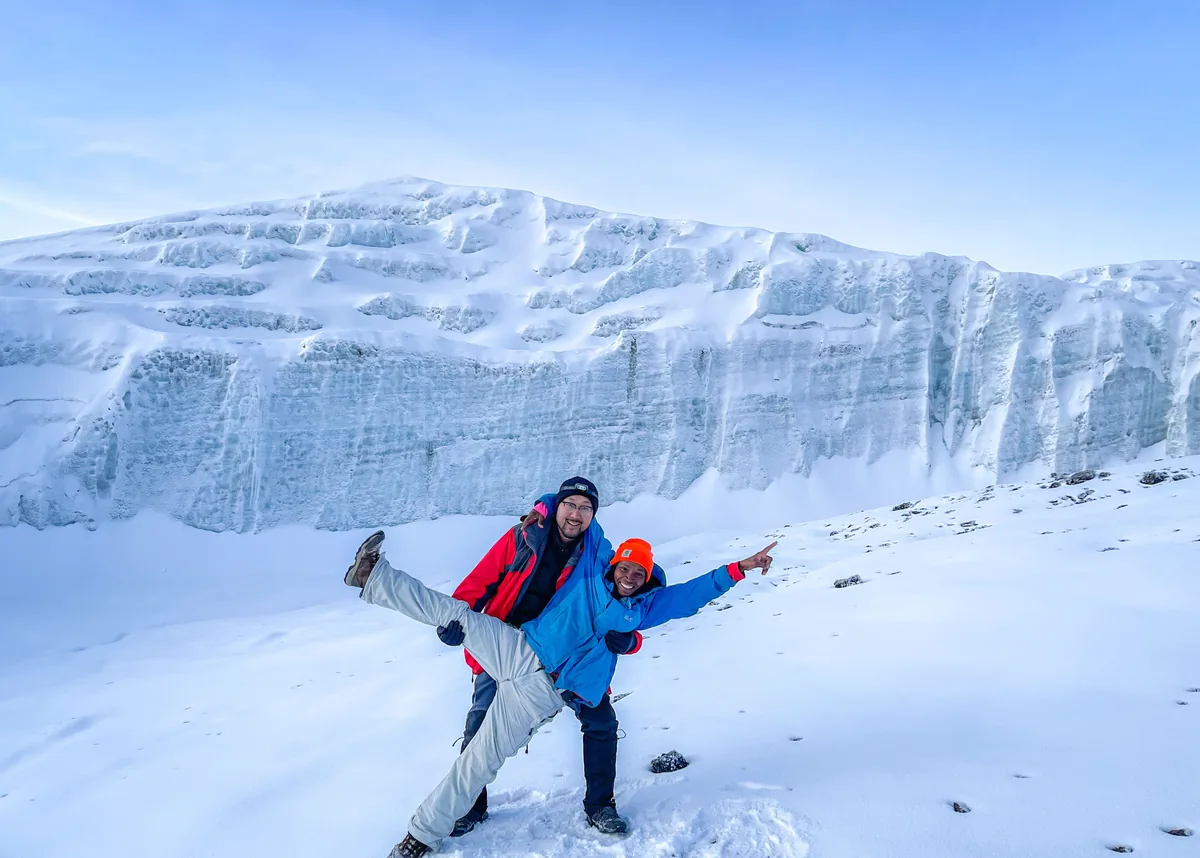
The trail rises to Gilman’s Point and Stella Point before following the crater rim round to Uhuru Peak. At 5,895 metres it is the highest point in Africa, and you will watch the sun come up from it.

Then the long way down — through Kibo Hut and across the upper slopes to Horombo, where you spend the night.

Summit
5,895 m (+1,233 m)
Ascent
5–7 hours
Descent
5–6 hours, approx. 2,205 m lost
Habitat
Alpine desert / summit zone
Meals
Breakfast, lunch & dinner
Overnight
Horombo Hut
Highlight
Sunrise from Uhuru Peak, the highest point in Africa
Day 7 07

Horombo Hut – Marangu Gate – Arusha or Moshi

The final descent goes down through heathland and rainforest to Marangu Gate — a different side of the mountain from the one you came up.

At the gate you collect your summit certificate and mark the climb with your crew.

Your vehicle then takes you back to Arusha or Moshi for a well-earned rest.

Elevation
Approx. 3,690 m – 1,860 m
Distance
Approx. 15–16 km
Hiking
5–6 hours
Habitat
Rainforest
Meals
Breakfast & lunch

What the rate covers

Everything below is settled before you travel. What isn’t covered is listed just as plainly, so nothing on this trip arrives as a surprise.

Included

  • Airport transfers from Kilimanjaro International Airport or Arusha Airport
  • Hotel-to-gate and return transfers
  • A professional mountain guide
  • An experienced mountain crew and adequate porters
  • A mountain cook, and fresh meals throughout the trek
  • Kilimanjaro National Park entrance and conservation fees
  • Rescue fees
  • Camping and hut fees
  • Mountain camps and huts along the route
  • Quality mountain tents where the route camps rather than uses huts
  • Mess and cooking facilities
  • A sleeping mattress
  • Walking poles
  • An oximeter and an emergency oxygen cylinder, with daily altitude monitoring
  • A medical kit
  • Drinking water, approximately 3 litres a day
  • Storage for excess luggage not needed on the mountain
  • A hot shower and a complimentary massage after the descent
  • VAT and applicable government taxes

Not included

  • International or domestic flights
  • Personal hiking and mountain equipment
  • Travel insurance
  • Tips for the mountain crew
  • A private toilet, available at an additional cost
  • Additional porter services
  • Personal expenses

Questions

Why climb from the north?
Two reasons. Rongai is much the quietest of the main routes, so you share the trail with far fewer people than on Machame or Marangu. And the northern side sits in the mountain’s rain shadow, so when the southern slopes are wet the going up here is often noticeably drier.
Do I need mountaineering experience?
No. Kilimanjaro is a trek rather than a technical climb, and no route on it needs ropes or rock skills. What it does need is preparation, determination and a good level of fitness — and enough days on the mountain to acclimatise, which is why we sell the longer versions of each route.
What happens about the altitude?
Your guide checks your oxygen saturation and pulse with an oximeter every day and sets the pace off what he sees. An emergency oxygen cylinder and a medical kit go up the mountain with the crew. Every itinerary here is built around acclimatisation — the extra night, the climb-high-sleep-low day at Lava Tower — rather than the shortest line to the summit.
Can you cater for my diet?
Yes. Vegetarian, vegan, halal and gluten-free meals can all be arranged with advance notice — tell us when you book and the mountain cook will carry what he needs.
Can I add a safari or Zanzibar afterwards?
Most people do. The climb ends back in Arusha or Moshi, an easy transfer from the northern circuit, so it joins straight onto a private safari through Tarangire, Ngorongoro and the Serengeti — or onto a flight to Zanzibar for a few days by the Indian Ocean. Tell us at the enquiry stage and we will draft the whole thing as one journey.

Travel this one

Tell us roughly when, and we’ll come back with dates, the camps that are open and what the 7-day rate looks like for your party.

Or reach the team in Arusha directly — +255 654 592 688 or WhatsApp.

We reply within one working day.