
Safari Add-ons
Things you can add to a safari
Fourteen of them, and where each one is actually possible.
Every itinerary on this site is private, so there is room in it. A balloon over the Serengeti at dawn, a night drive in Tarangire, a morning on foot with a ranger, a table laid in the open for breakfast — none of it is in the rate, and all of it can be added to the day it belongs on.
What matters as much as the list is where each one is real. Only two northern parks permit driving after dark. Balloons launch from the central and southern Serengeti and from Tarangire. The zipline is at Mto wa Mbu, which most of these journeys drive through anyway. Open an itinerary and you will see the add-ons offered under the days they can actually happen on.
Hot air balloon safari
A sunrise flight over the plains, then a champagne breakfast under an acacia.
- Where
- Central & southern Serengeti, Tarangire
- How long
- 3–4 hours, pre-dawn pick-up
- Price
- On request
- Who can
- Ages 7+ · about 120 kg per person
You are collected from camp between 04:30 and 05:00 and driven to the launch site, where the balloon is inflated in the dark. Take-off is around 06:30, and the flight itself lasts 45 to 60 minutes — the pilot works the altitude, skimming the treetops for the wildlife and climbing for the scale of the thing.
Baskets are shared, usually 8 to 16 passengers. You land somewhere in the wilderness, drink the traditional glass of champagne, and are taken to a private site for a full bush breakfast laid on linen. It is the one activity on this list worth booking months ahead; peak-season flights sell out.
It is not flown during pregnancy, and the operators ask anyone with back, neck or heart trouble, or recent surgery, to speak to their doctor first.
Where it runs
-
Serengeti
Launches from the central Seronera area or from Ndutu in the south, depending on the season.
-
Tarangire
Northern and central zones, over the river, the baobabs and the elephant herds. Quieter than the Serengeti flights.
Best time
June–October for the migration in the north and Tarangire at its driest; December–March over the calving grounds at Ndutu.
Night game drive
Two or three hours after sunset with a spotlight, for the animals the day never shows you.
- Where
- Lake Manyara and Tarangire only
- How long
- 2–3 hours, starting just after sunset
- Price
- On request
Only two parks in the north permit driving after dark, and both are on these itineraries. You go out in an open vehicle with your guide and a spotlight operator, and the cast changes completely: civets, genets, porcupines, bush babies, hippos out of the water and grazing, and the predators that spend the day asleep under a bush.
The sky is half the reason to go. There is almost no light pollution out there, and guides will help you set up a long exposure rather than a flash.
Where it runs
-
Lake Manyara
Hippos come ashore, bush babies work the canopy, and the tree-climbing lions are occasionally out hunting.
-
Tarangire
Fewer vehicles and more space. Baobab country in the dark, with elephant somewhere close.
Best time
Year-round. Take a warm jacket — the bush gets cold after dark.
Walking safari
The same ground as the animals, on foot, with an armed ranger and a naturalist.
- Where
- Arusha NP, Ngorongoro highlands, Tarangire, select Serengeti areas
- How long
- 2–4 hours over uneven ground
- Price
- On request
- Who can
- Ages 8+ · moderate fitness
A walking safari is slow on purpose. You stop for tracks, for dung, for a medicinal plant, for the ant lion and the leopard tortoise that nobody photographs from a vehicle — and you watch the big animals from a distance a guide chooses rather than one you drive up to.
You are never out there alone: an armed ranger and a trained naturalist walk with you, and the route avoids anything that needs avoiding. Expect two to four hours on uneven ground. Gentler nature walks in less predatory areas can take children from about four; anything in big-game country is eight and up. Wear neutral colours — khaki, olive, brown. Bright colours and white are discouraged for a reason.
Where it runs
-
Arusha National Park
The best place to start: forest, waterfalls and glades, colobus monkeys, giraffe and buffalo around the Momella Lakes.
-
Ngorongoro highlands
The crater rim for the view down, or the descent into Empakaai, where the flamingos are.
-
Tarangire
The riverine stretches, among the baobabs and the elephant.
-
Serengeti
Permitted in select areas only, and usually paired with a drive.
Best time
Dry season, when the grass is short and the tracks are readable.
Bush breakfast
A table laid in the open, found at the end of a pre-dawn game drive.
- Where
- Serengeti, Ngorongoro crater rim, Tarangire
- How long
- A morning, after the first drive
- Price
- From US$ 50 pp
- Also worth knowing
- Some lodges include one bush meal per stay — worth checking before you add it.
You go out for the early drive, round a corner, and find a table set in a scenic spot — above a river full of hippos, or on a ridge over the plains. A chef cooks eggs to order; there is fruit, pastry, Tanzanian honey and coffee, and sparkling wine if you want the champagne version.
The site is scouted in advance and an armed ranger or your guide stays with you, which is what lets you sit down and eat slowly in the middle of a national park.
Where it runs
-
Serengeti
Open plains, and the migration somewhere on the horizon if the timing is right.
-
Ngorongoro crater rim
Cold, clear highland air and the whole caldera below you.
-
Tarangire
Under a baobab, with elephant moving in the distance.
Best time
Dry season for clear skies and short grass; January–February on the calving plains for the drama.
Sundowner
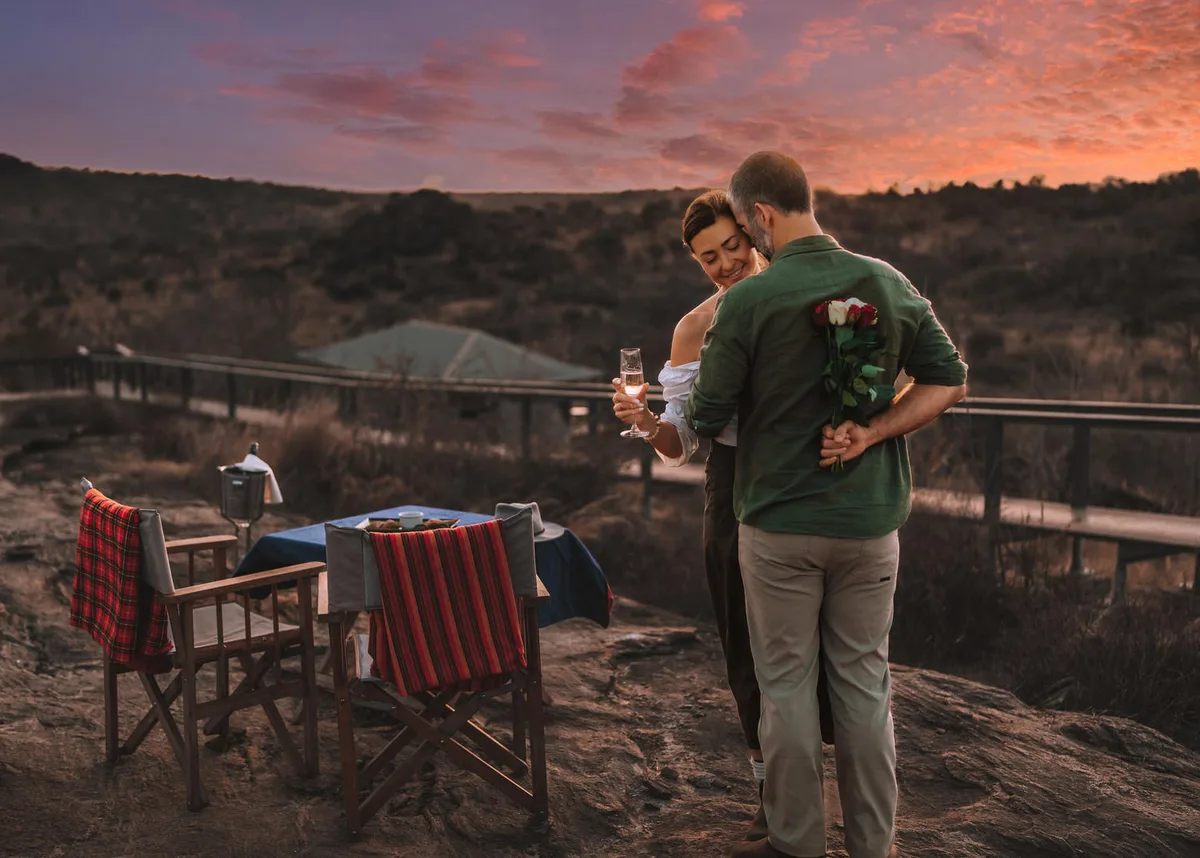
Chairs, a small fire and a drink at a spot your guide has picked, as the light goes.
- Where
- Serengeti, Tarangire, Ngorongoro crater rim
- How long
- The last hour of the afternoon drive
- Price
- From US$ 50 pp
The afternoon drive ends somewhere chosen rather than convenient — a kopje in the Serengeti, a bend of the Tarangire river, a ridge on the crater rim. Waiting there: safari chairs, a linen-covered table, a small fire and a bar, with biltong, nuts, samosas and canapés.
The classic is a gin and tonic, originally for the quinine. There is also South African wine, Tanzanian beer, cocktails and juice. Ask us in advance and the same setup does proposals, anniversaries and birthdays.
Where it runs
-
Serengeti
A rocky kopje, a lone acacia, and the predators starting to stir.
-
Tarangire
Baobab silhouettes against a purple sky.
-
Ngorongoro crater rim
High, cool and panoramic, with the caldera floor falling into shadow.
Best time
Any day of the year. The dry season gives the cleanest gold; the green season gives you storm clouds.
Maasai boma visit
Time inside a working homestead — the welcome dance, the house, the herd, the beadwork.
- Where
- Ngorongoro, Serengeti buffer zones, Longido & West Kilimanjaro
- How long
- A short stop, or a half-day medicine walk
- Price
- From US$ 20 pp
- Also worth knowing
- The deeper bush-and-elder version runs US$ 70–120 pp. Fees generally go to community funds — water, school fees, healthcare.
You are usually met with the adumu, the jumping dance, and then taken inside a boma — mud, sticks and grass, cool and dark — where an elder talks about the family, the cattle that measure their wealth, and their claim on the land. Depending on the hour you may see the herd brought in, beadwork being made, or a fire started with two sticks.
How we run it matters more than what it costs. Photographs are asked for, not taken; your guide handles that. Rather than handing out sweets or cash, we would rather you bought the beadwork or put something into the village school fund.
Where it runs
-
Ngorongoro Conservation Area
Highland bomas where the Maasai live alongside grazing wildlife, under the crater rim.
-
Serengeti buffer zones
Communities on the park boundary, inside the conservation arrangements the migration runs through.
-
Longido & West Kilimanjaro
Further off the route, and the place for a medicine walk through the volcanic foothills.
Olduvai Gorge
The Leakeys’ dig, the 1.75-million-year-old skull, and a museum on the rim of the gorge.
- Where
- On the Ngorongoro–Serengeti drive
- How long
- A stop of an hour or so, on the way through
- Price
- US$ 35–40 pp
- Also worth knowing
- On top of the Ngorongoro Conservation Area fees you are already paying.
The road between the crater and the Serengeti runs past the most famous archaeological site in the world. This is where Louis and Mary Leakey worked for decades and where the 1.75-million-year-old "Zinjanthropus" came out of the ground, and the site museum on the rim is genuinely good — real fossils, Oldowan stone tools, and an explanation of how volcanic ash kept any of it.
It costs you an hour of a drive you are making anyway, and it changes the scale of the landscape you spend the next week in.
Where it runs
-
Olduvai Gorge
Between Ngorongoro and the Serengeti, with a lecture at the museum overlooking the gorge.
Best time
June–October, when the roads are dry and the geology is not hidden by foliage.
Lake Manyara treetop walk
Nine suspension bridges through the canopy, at the park gate.
- Where
- Lake Manyara, at the entrance gate
- How long
- 30–60 minutes
- Price
- From US$ 20 pp
- Who can
- Ages 5+ · under-fives are not permitted on the bridges
- Also worth knowing
- Lake Manyara park entry (about US$ 59) is separate.
The walkway starts at ground level and climbs into the canopy across nine netted suspension bridges. It is a short, easy thing to do — blue monkeys, baboons, butterflies, and a guide pointing out the plants of a groundwater forest that exists because of the springs under it.
It sits right at the Manyara gate, which makes it the natural start or finish to a day in the park rather than an excursion of its own.
Where it runs
-
Lake Manyara National Park
At the entrance gate, so it slots into the morning you drive in or the afternoon you leave.
Best time
Dry season for the light and the sightlines; green season for a forest at its most vivid.
Zipline at Mto wa Mbu
Four or five zips off the Rift Valley escarpment, above the Maasai Steppe.
- Where
- Mto wa Mbu, at the foot of the escarpment
- How long
- 2–3 hours, including the ride out
- Price
- From US$ 55 pp
- Who can
- Ages 7+ · 23–130 kg
The only world-class zipline course on the northern circuit is built into the foothills of the Rift Valley escarpment at Mto wa Mbu — which every one of these itineraries drives through on the way to Manyara or the crater. You are kitted out at the village office, then taken on a 20-minute open-air ride through Maasailand to the course.
Four to five zips of different lengths link six platforms, and the last one is the long one, out over the valley. Guides are trained to international standards and the gear is theirs. It is not run during pregnancy.
Where it runs
-
Mto wa Mbu
Between Arusha and the parks, at the base of the Great Rift Valley escarpment.
Best time
June–October and January–March, when the platforms are dry and the valley is clear.
Quad biking
Automatic 450cc quads through the highland farms and the buffer zones. No experience needed.
- Where
- Karatu & the Ngorongoro highlands, Arusha, Lake Manyara buffer
- How long
- 2 hours, or a half day
- Price
- From US$ 100 pp
- Also worth knowing
- Half-day wilderness expeditions run US$ 180–250 pp.
It starts with a briefing and a practice loop, because most people have never ridden one. Helmets, goggles and dust masks are provided, the bikes are automatic, and a lead rider sets a pace that suits whoever is slowest.
The routes go through brick-making villages, coffee plantations and grazing land, with stops at the viewpoints. You will get dusty or muddy, and then you will go back to the lodge for a shower and a drink.
Where it runs
-
Karatu & the Ngorongoro highlands
Green foothills, coffee farms and the volcanic escarpment behind them.
-
Arusha & the Meru foothills
Forest edges and Maasai grazing land, with Meru and Kilimanjaro in view.
-
Lake Manyara buffer zones
Flat, dusty, sun-cracked plains, with zebra and wildebeest out on them.
Best time
Dry season for firm, fast trails and a great deal of dust; January–March for green hills and a more technical, muddier ride.
Biking
Mountain bikes through villages, plantations and one of the few parks that allows them.
- Where
- Mto wa Mbu & Manyara, Arusha NP, Kilimanjaro foothills
- How long
- 2–4 hours, or a full day
- Price
- From US$ 50 pp
- Also worth knowing
- A full-day ride with a support vehicle and a private picnic runs US$ 120–180 pp.
Bikes, helmets and hydration packs are provided, and on longer routes a support vehicle stays near with cold water and a seat if you have had enough. The ground is a mix of red dirt, sandy village paths and the occasional stretch of tarmac.
You will not be cycling among lions, but in the buffer zones and the conservancies you ride within sight of zebra, giraffe and gazelle — and at eye level with everyone you pass, which is the real difference from a vehicle.
Where it runs
-
Mto wa Mbu & Lake Manyara
The village ride: rice paddies, market, forest galleries, and the lakeshore with its flamingos and hippos.
-
Arusha National Park
One of the few parks you may cycle inside — past the Momella Lakes, with Meru above you.
-
Kilimanjaro foothills
Steep climbs and fast descents through Chagga farmland, in the shadow of the mountain.
Best time
June–October, when the trails are firm. Avoid April and May — the long rains turn most of them to mud.
Canoeing
Two or three hours on flat water, at eye level with the birds and the hippos.
- Where
- Lake Manyara, Momella Lakes, Lake Duluti
- How long
- 2–3 hours
- Price
- From US$ 60 pp
- Also worth knowing
- Park entry is extra at Manyara and Arusha NP. A combined hike-and-paddle day runs US$ 120–150 pp.
Stable two-person canoes, life jackets, a briefing and a guide who keeps a respectful distance from the hippos. The pace is gentle and first-timers are fine.
It is the birding activity on this list — flamingos in their thousands, malachite kingfishers, herons — with buffalo, bushbuck and monkeys along the wooded banks.
Where it runs
-
Lake Manyara
When the water is high: flamingos, and elephant grazing the floodplain. Seasonal.
-
Momella Lakes, Arusha NP
Hippo and buffalo from the water, with Meru and Kilimanjaro behind.
-
Lake Duluti
A forested crater lake twenty minutes from Arusha. Quiet, and full of birds.
Best time
Dry season for calm water and concentrated wildlife; January–March for the migratory birds. Manyara depends on water levels — worth checking.
Horse riding
Out among the plains game on horseback, which lets you get closer than a vehicle does.
- Where
- Dolly Estate (Arusha & Kilimanjaro), Manyara Ranch
- How long
- Two hours, longer for experienced riders
- Price
- From US$ 150 pp
- Who can
- Ages 7+ · 90–95 kg maximum
- Also worth knowing
- Two hours, as quoted in the operator’s own Arusha itinerary. Multi-day riding safaris are a separate trip.
Wildlife reads a horse as another animal rather than as a threat, so giraffe, eland and antelope let you come far closer than they would a vehicle. The horses are chosen for temperament and stamina, helmets are provided and mandatory, and the guides are professional equestrians.
Beginners walk through the game corridors and look at the scenery. If you can ride, there are canters and gallops along old wildlife trails. Bring long trousers and closed shoes with a small heel, in neutral colours; the weight limit is for the horses’ sake, and multi-day rides are for intermediate riders and up, aged twelve and over.
Where it runs
-
Dolly Estate, Arusha
All levels, families included. Meru and Kilimanjaro in view, with eland, zebra and the occasional gerenuk.
-
Manyara Ranch
A private wildlife corridor with elephant and giraffe and almost no traffic.
Spa treatment
A massage at the lodge, sometimes on your own deck, usually with a view.
- Where
- Serengeti camps, Ngorongoro highlands, Zanzibar
- How long
- 60–90 minutes
- Price
- From US$ 80 pp
- Also worth knowing
- A full-body ritual or scrub runs US$ 120–200 pp.
Depending on the property this is a glass-fronted room, a tented pavilion over a waterhole, or a table set up on your own deck. Therapists at the lodges we use are trained to international standards.
The signature treatments are worth asking for by name: a foot ritual with volcanic sand and local herbs, a hot-stone massage using river stones, and a body scrub made with Tanzanian coffee.
Where it runs
-
Serengeti camps
In-tent treatments at the high-end camps, mobile therapists at the rest.
-
Ngorongoro highlands
Cool, green and misty — the forest-sanctuary version.
-
Zanzibar
The spice spas, where clove, nutmeg and cinnamon go into the treatments.
Best time
Any time. Most welcome after the dusty days, or at the end of a trekking or walking itinerary.
How Add-ons Are Priced
Quoted with your itinerary, not bolted on later
The figures on this page are per person and indicative — they move with the season, the property and the size of your party, and they are confirmed in writing with your itinerary before you pay anything. Park and conservation fees are separate where an activity happens inside a park.
Balloon flights, night game drives and walking safaris are quoted on request: they are run by the camps and the park operators at rates that change, and we would rather give you the real number than a stale one. Balloons in particular sell out in peak season, so ask early.
Some lodges already include a bush meal or a spa treatment in their rate. Where that is true of the property on your itinerary, we will tell you rather than sell you the same thing twice.
Next Step
Tell us which of these you want
Name the ones that appeal and we will put them on the right days and price them into your itinerary. If something here does not fit the route you have chosen, we will say so rather than sell it to you.
Stay In Touch
Letters from the wild places
Camp news, new routes and the occasional photograph worth stopping for. Six times a year, never more.