Polecat Safaris
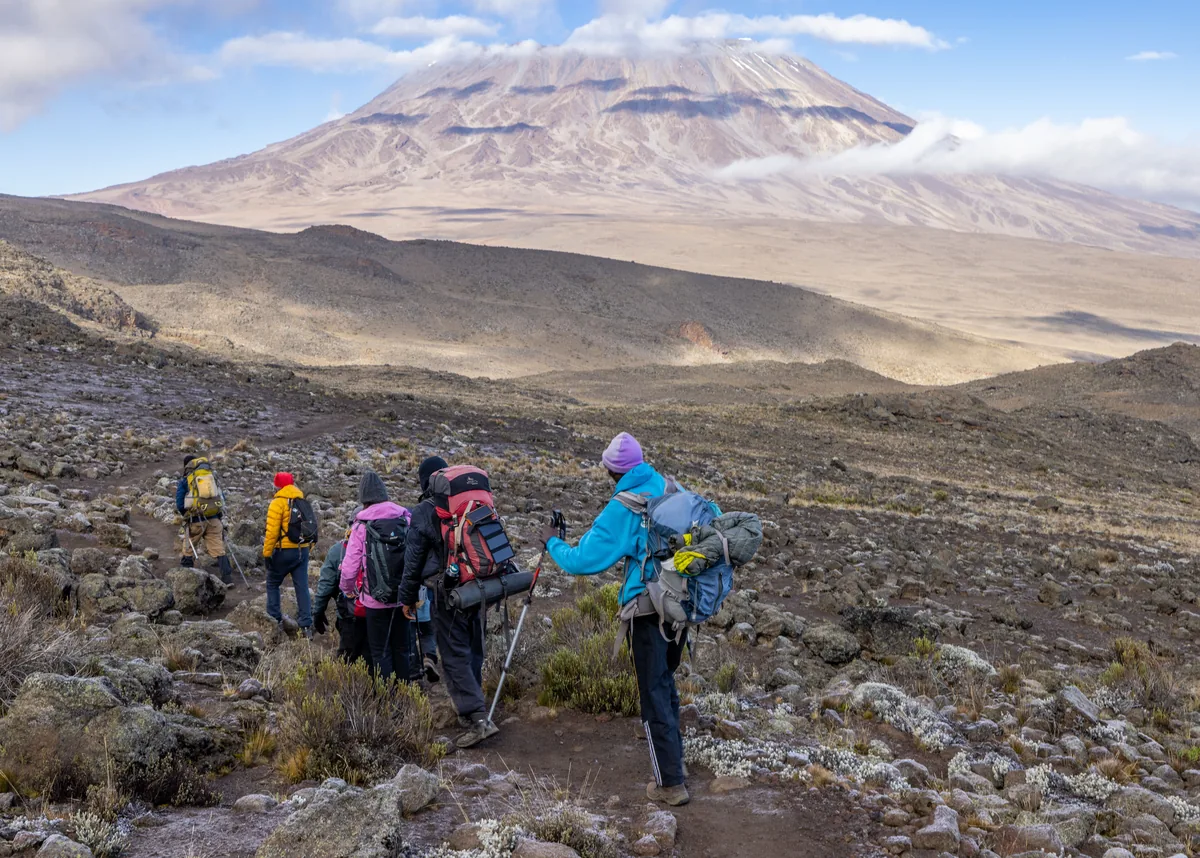
A line of trekkers with poles and packs climbing a heathland traverse on Kilimanjaro, cloud banked against the ridge behind them

Kilimanjaro Trek

6-Day Marangu Route

Duration
6 Days
From
US$ 2,160 per person

Overview

The classic way up Kilimanjaro, and the only main route where you sleep in permanent huts rather than tents. Six days rather than five, so there is an extra acclimatisation night at Horombo before the summit — rainforest, heathland and the alpine desert of the Saddle, then Uhuru Peak at 5,895 metres.

  • The classic Kilimanjaro route, and the most established on the mountain
  • Mountain huts every night rather than tents
  • An extra acclimatisation night at Horombo before the summit stages
  • Rainforest, open heathland and the alpine desert of the Saddle in six days
  • Uhuru Peak at 5,895 metres — the highest point in Africa
  • A private mountain guide, a full crew and a mountain cook
  • Daily oxygen-level monitoring, with emergency oxygen carried throughout
  • A hot shower and a complimentary massage waiting at the bottom
Duration
6 days, 5 nights
Destination
Kilimanjaro National Park
Stops
6
Experience
Kilimanjaro Trek
Best time
January – March & June – October

The route, and how far apart these places are

Arusha · Marangu Gate · Mandara Hut · Horombo Hut · Kibo Hut · Uhuru Peak

Route Map

Day by day

Every day here is private — your own guide and your own vehicle — so the order holds but the hours are yours to move.

Day 1 01

Arusha – Marangu Gate – Mandara Hut

Your climb begins with a transfer from Arusha to Marangu Gate, where registration and the park formalities are done.

From the gate you walk up through lush rainforest towards Mandara Hut, with birdlife along the trail and, often, the blue colobus monkeys the forest is known for.

The afternoon is yours — rest around the huts, or walk up to the nearby Maundi Crater for the view north towards Kenya.

Elevation
1,860 m – 2,700 m
Distance
Approx. 8 km
Hiking
4–5 hours
Habitat
Rainforest
Meals
Breakfast, lunch & dinner
Overnight
Mandara Hut
Day 2 02

Mandara Hut – Horombo Hut

After breakfast the forest thins and gives way to open heathland, and the mountain opens up with it — Kibo and Mawenzi ahead of you for much of the day.

The trail climbs steadily to Horombo Hut. This is usually where the altitude first makes itself felt, so the pace stays deliberate and the water bottle stays in your hand.

Elevation
2,700 m – 3,700 m
Distance
Approx. 12 km
Hiking
5–6 hours
Habitat
Heathland
Meals
Breakfast, lunch & dinner
Overnight
Horombo Hut
Day 3 03

Horombo Hut – Acclimatisation Day

A second night at Horombo, and a day given over to letting your body catch up with the altitude.

Depending on conditions and on how you are feeling, your guide will take you on a gradual acclimatisation walk towards the Mawenzi side of the mountain before you drop back to camp.

This is the day that makes the six-day Marangu a better bet than the five.

Habitat
Heathland / alpine zone
Meals
Breakfast, lunch & dinner
Overnight
Horombo Hut (Cont.)
Highlight
An extra day at 3,700 m, spent acclimatising rather than climbing
Day 4 04

Horombo Hut – Kibo Hut

Today you cross the Saddle, the high-altitude desert lying between Mawenzi and Kibo. The vegetation gives out almost entirely and the landscape turns to rock and dust.

Kibo Hut sits at roughly 4,700 metres. Dinner is early, and so is bed — you will be woken not long after midnight.

Elevation
3,700 m – 4,700 m
Distance
Approx. 9 km
Hiking
5–6 hours
Habitat
Alpine desert
Meals
Breakfast, lunch & dinner
Overnight
Kibo Hut
Day 5 05

Kibo Hut – Uhuru Peak – Horombo Hut

Summit day starts shortly after midnight with a hot drink and a light meal, and then the climb under the stars.

The trail works its way up to Gilman’s Point and Stella Point on the crater rim, and from there along the rim to Uhuru Peak. At 5,895 metres it is the highest point in Africa.

Take the time you need at the top, then begin the long descent — back down to Kibo Hut, and on to Horombo for the night.

Summit
5,895 m — Uhuru Peak
Ascent
Approx. 5–7 hours
Descent
Approx. 5–6 hours
Habitat
Alpine desert
Meals
Breakfast, lunch & dinner
Overnight
Horombo Hut
Highlight
Uhuru Peak at sunrise — the Roof of Africa
Day 6 06

Horombo Hut – Marangu Gate – Arusha

The last descent runs back down through the heathland and the rainforest to Marangu Gate.

At the gate you collect your Kilimanjaro certificate and mark the climb with the crew who got you up it.

Your private transfer then takes you back to Arusha or Moshi, and a shower, a massage and a bed that is not a bunk.

Elevation
3,700 m – 1,860 m
Distance
Approx. 20 km
Hiking
4–6 hours
Habitat
Rainforest
Meals
Breakfast & lunch

What the rate covers

Everything below is settled before you travel. What isn’t covered is listed just as plainly, so nothing on this trip arrives as a surprise.

Included

  • Airport transfers from Kilimanjaro International Airport or Arusha Airport
  • Hotel-to-gate and return transfers
  • A professional mountain guide
  • An experienced mountain crew and adequate porters
  • A mountain cook, and fresh meals throughout the trek
  • Kilimanjaro National Park entrance and conservation fees
  • Rescue fees
  • Hut fees
  • Mountain hut accommodation
  • Mess and cooking facilities
  • A sleeping mattress
  • Walking poles
  • An oximeter and an emergency oxygen cylinder, with daily altitude monitoring
  • A medical kit
  • Drinking water, approximately 3 litres a day
  • Storage for excess luggage not needed on the mountain
  • A hot shower and a complimentary massage after the descent
  • VAT and applicable government taxes

Not included

  • International or domestic flights
  • Personal hiking and mountain equipment
  • Travel insurance
  • Tips for the mountain crew
  • A private toilet, available at an additional cost
  • Additional porter services
  • Personal expenses

Questions

What is the accommodation like on Marangu?
Marangu is the only main Kilimanjaro route with permanent huts, so you sleep in a bunk under a roof rather than in a tent — at Mandara, Horombo and Kibo. Sleeping mattresses are provided; a warm sleeping bag is not, and you should bring one rated for sub-zero nights.
Do I need mountaineering experience?
No. Kilimanjaro is a trek rather than a technical climb, and no route on it needs ropes or rock skills. What it does need is preparation, determination and a good level of fitness — and enough days on the mountain to acclimatise, which is why we sell the longer versions of each route.
What happens about the altitude?
Your guide checks your oxygen saturation and pulse with an oximeter every day and sets the pace off what he sees. An emergency oxygen cylinder and a medical kit go up the mountain with the crew. Every itinerary here is built around acclimatisation — the extra night, the climb-high-sleep-low day at Lava Tower — rather than the shortest line to the summit.
Can you cater for my diet?
Yes. Vegetarian, vegan, halal and gluten-free meals can all be arranged with advance notice — tell us when you book and the mountain cook will carry what he needs.
Can I add a safari or Zanzibar afterwards?
Most people do. The climb ends back in Arusha or Moshi, an easy transfer from the northern circuit, so it joins straight onto a private safari through Tarangire, Ngorongoro and the Serengeti — or onto a flight to Zanzibar for a few days by the Indian Ocean. Tell us at the enquiry stage and we will draft the whole thing as one journey.

Travel this one

Tell us roughly when, and we’ll come back with dates, the camps that are open and what the 6-day rate looks like for your party.

Or reach the team in Arusha directly — +255 654 592 688 or WhatsApp.

We reply within one working day.